



 Comment
The integration of Meta Muse with Shopify and Shop Pay signals a new stage for ecommerce, where AI agents can discover products and help consumers complete purchases.
Published on2 October 20264Views0 Reviews0 Comments

Artificial intelligence is entering a new phase in ecommerce. Until recently, most consumer-facing AI experiences focused on answering questions, providing recommendations or helping people compare products. Agentic AI takes this further by allowing software to perform tasks on a user's behalf, including parts of the shopping and purchasing process.
The integration of Meta Muse with Shopify and Shop Pay is a significant example of this evolution. It creates a model in which consumers can discover products and progress towards a purchase with the assistance of an AI agent, potentially reducing the number of steps between product discovery and transaction.
For brands using Shopify, this development raises an important question: is your online store prepared for a world where the customer discovering your products may be assisted by an AI agent interpreting your catalogue?
From conversational assistants to shopping agents
Generative AI initially became familiar to consumers through conversational interfaces. A user asks a question, and the system provides an answer. Agentic systems extend that model by allowing AI to carry out selected actions according to the user's instructions.
Ecommerce is a natural environment for this technology. A shopper could describe what they need, specify a budget, size, colour, material or other requirements and ask an agent to identify suitable products. The agent can then use available product information to compare alternatives and help move the customer towards a transaction.
This has the potential to change the traditional customer journey. Instead of beginning exclusively on Google, a social network, a marketplace or an ecommerce website, a purchase can begin inside a conversation with an AI assistant.
For businesses, this means that digital marketing strategies will increasingly need to consider AI platforms as additional environments for product discovery and conversion.
What changes with Meta Muse and Shopify?
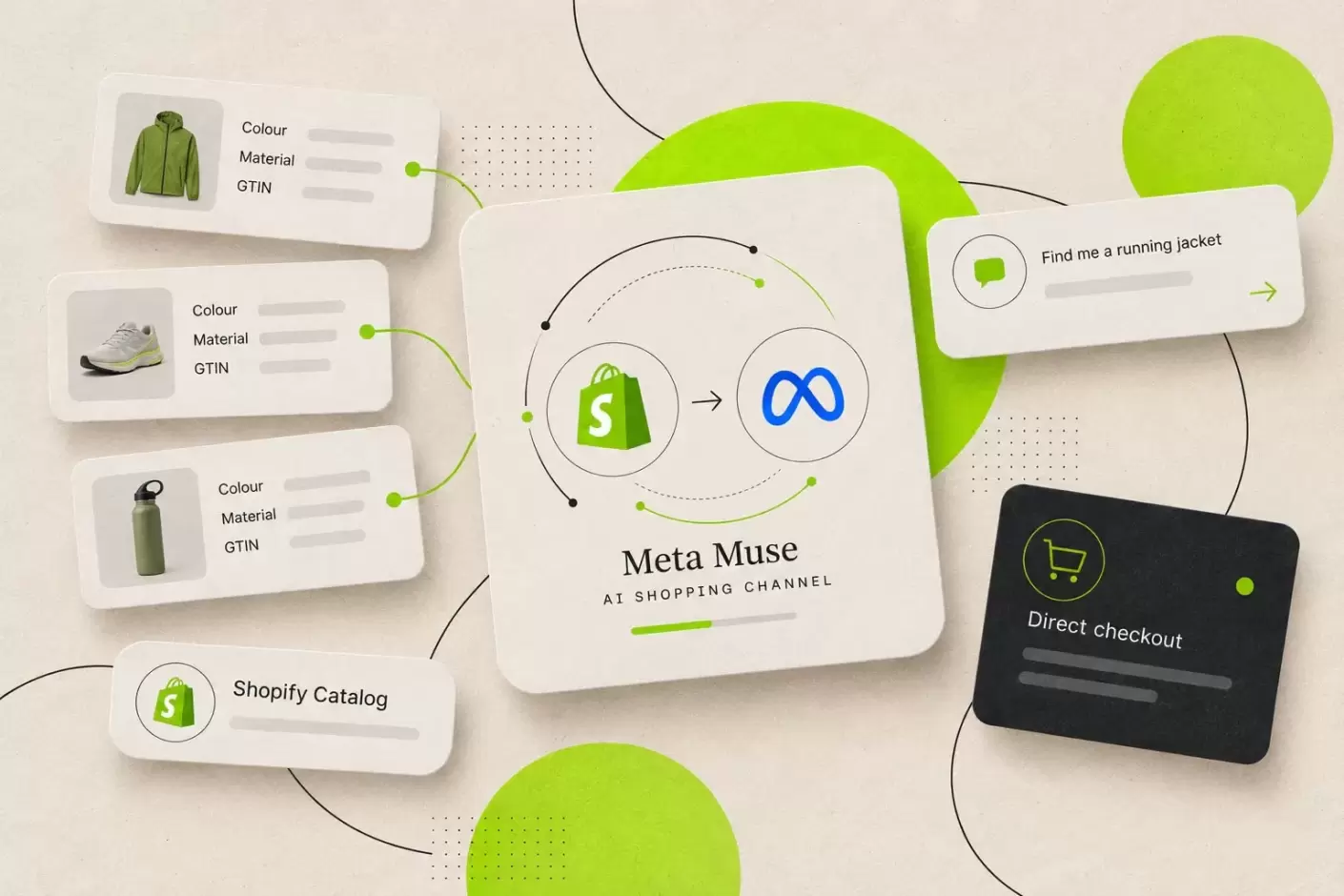
The collaboration connects Meta's Muse assistant with Shopify's commerce ecosystem. When a consumer uses Muse for shopping, the assistant can use product information available through Shopify's catalogue infrastructure to identify relevant products.
Shop Pay is an important part of this model because it can streamline the payment experience. Where direct checkout is available and the merchant is eligible, the customer may be able to complete the purchase without following the conventional journey through the retailer's storefront.
From the merchant's perspective, Shopify remains an important part of the transaction infrastructure. The order can still enter the merchant's ecommerce environment, while the discovery and purchasing journey may happen partly through another platform.
The initial rollout is particularly relevant to merchants selling to customers in the United States. However, the wider importance of the development goes beyond one market. It demonstrates how ecommerce infrastructure may evolve as AI assistants become increasingly capable of carrying out transactions.
The product catalogue becomes strategic infrastructure
When a person visits an online store, they can often interpret information even when it is not perfectly structured. They can look at photographs, read several paragraphs and understand that a particular jumper is blue, made from wool and available in three sizes.
An AI shopping agent also needs to identify these characteristics reliably. This makes the quality and structure of product data increasingly important.
Titles, descriptions, prices, availability, variants, colours, materials, dimensions, sizes and categories should be clearly defined. Important product information should not depend exclusively on descriptive copy written for a human reader.
Within Shopify, product options, metafields and structured attributes can help businesses organise this information more effectively. A well-maintained catalogue is useful not only for the online store itself, but also for search engines, marketplaces, advertising platforms and emerging AI shopping channels.
From SEO to AI-driven product discovery
Traditional SEO remains fundamental to ecommerce visibility, but AI assistants introduce another layer to the discovery process.
Businesses increasingly need to consider not only whether a page can rank in a search engine, but also whether their products can be accurately understood, compared and selected by automated systems.
This does not mean replacing existing optimisation practices. Many of the foundations remain the same: clear architecture, consistent information, crawlable content, accurate product data and technically reliable websites are valuable across multiple discovery environments.
A comprehensive technical SEO strategy can therefore extend beyond conventional search visibility to consider how catalogue structure, metadata and technical implementation support different systems that consume product information.
Product data may become a competitive differentiator
For many ecommerce businesses, product data has historically been treated as an operational requirement. Titles need to exist, prices need to be correct and stock needs to be updated. Agentic commerce gives this information a more strategic role.
Imagine two retailers selling similar products. One has detailed categories, consistent variant names, accurate materials, structured dimensions and comprehensive product descriptions. The other relies on inconsistent titles and places important attributes inside unstructured paragraphs.
A human shopper may still be able to understand both stores. A system trying to identify the most relevant product for a precise request may find the first catalogue significantly easier to interpret.
This means ecommerce teams may need to treat product information with the same attention previously given to website design, advertising creative and conversion optimisation.
Analytics will also need to evolve
Measurement presents another important challenge. Ecommerce teams are accustomed to analysing journeys through browser-based analytics, advertising pixels and events triggered when users interact directly with the website.
If a transaction is completed through an external AI environment, part of the journey may occur without the customer's browser loading the merchant's storefront. Traditional tracking methods may therefore have less visibility over some interactions.
This increases the importance of server-side events, reliable order attribution and integrations between ecommerce platforms, CRM systems, advertising tools and analytics environments.
Businesses should understand which parts of their current measurement infrastructure depend on browser activity and how transactions originating from AI channels will appear in reporting. The objective is not simply to collect more data, but to maintain a reliable view of acquisition and conversion as customer journeys become more distributed.
Does agentic commerce make the online store less important?
The growth of AI-assisted purchasing does not mean ecommerce websites are about to disappear. A brand's website remains essential for communication, trust, content, customer service and many types of shopping experience.
What may change is the percentage of customers who need to visit the website directly before making a purchase.
Some journeys will continue to begin and end on the merchant's website. Others may begin on search engines, social platforms, marketplaces or AI assistants. In certain situations, a consumer may eventually complete a transaction without visiting the retailer's storefront at all.
This changes the role of ecommerce technology. An online store is not only a visual interface - it is increasingly a commerce infrastructure capable of distributing products, prices, inventory and business rules across multiple channels.
Shopify as a connection point for AI commerce
One of the most interesting aspects of Shopify's approach is the possibility of using a central product catalogue across multiple discovery environments.
Instead of creating a completely independent product integration for every new AI assistant, merchants can potentially maintain a central source of product information that can be distributed to different channels.
This becomes increasingly valuable as the number of AI systems participating in shopping journeys grows. Maintaining accurate information once and making it available across multiple environments is considerably more scalable than rebuilding catalogue logic for every emerging platform.
Businesses evaluating this architecture may benefit from considering Shopify Plus ecommerce solutions when they need to connect catalogue management, operations, internal systems and multiple sales channels within a more advanced commerce infrastructure.
How to prepare a Shopify store for agentic commerce
Agentic commerce is still developing, but businesses can already improve the foundations that determine how effectively their products can be understood and distributed.
- Review product catalogue quality. Titles, descriptions, categories, variants and important attributes should be accurate, consistent and complete.
- Structure important product attributes. Details such as colour, size, material, capacity or dimensions should not exist exclusively inside long-form descriptions.
- Keep price and inventory accurate. Automated shopping systems need current information to recommend products that customers can actually purchase.
- Review commercial policies. Terms of service, privacy information, returns and refund policies should be complete, current and accessible.
- Audit analytics and attribution. Identify which conversions may happen outside the website and determine how these orders will appear in analytics and commercial reporting.
- Review integrations and data ownership. Product information should have a reliable source of truth and should not depend on outdated feeds or systems that nobody within the organisation controls.
The product experience is no longer designed only for humans
Ecommerce design has traditionally focused on helping people find and purchase products. Navigation, search, filters, product pages and checkout experiences are designed to reduce human friction.
Agentic commerce introduces another consumer of product information: software.
This creates two simultaneous requirements. The visual experience still needs to be attractive, accessible and intuitive for people, while the technical structure must allow machines and AI agents to understand products accurately.
Businesses with fragmented product information, inconsistent taxonomies or unreliable integrations may face disadvantages compared with competitors whose data is easier for automated systems to interpret, even if both websites appear equally polished to a human visitor.
What should ecommerce teams avoid?
The rapid emergence of AI shopping creates a temptation to build specific solutions for every new assistant or platform. That approach can quickly become difficult to maintain.
A more sustainable strategy is to strengthen the underlying ecommerce infrastructure. If titles, attributes, inventory, pricing, policies and integrations are accurate at source, the same improvements can benefit multiple channels simultaneously.
This principle is particularly important because the AI commerce landscape is likely to continue changing. Individual assistants may evolve, new platforms may appear and technical requirements may be updated. Businesses should therefore avoid making their entire strategy dependent on a single agent.
The priority should be creating a discovery-ready and transaction-ready ecommerce foundation that can support search engines, marketplaces, advertising channels and AI systems.
A new stage for ecommerce
The integration of Meta Muse, Shopify and Shop Pay represents more than another sales channel. It illustrates a broader change in the relationship between consumers, ecommerce platforms and online stores.
For much of ecommerce history, the objective has been to attract traffic to a website and persuade the visitor to complete a transaction there. In an increasingly agentic environment, some purchases may begin inside a conversation and proceed through an integrated checkout while the merchant's ecommerce infrastructure operates behind the scenes.
In this context, competitive advantage will not depend solely on appearing in one particular AI assistant. Businesses will need strong product data, structured information, reliable integrations, current commercial policies and measurement systems capable of supporting increasingly fragmented customer journeys.
Meta Muse is an early example of this transition, but it is unlikely to be the last. Preparing an ecommerce operation so that its products can be accurately interpreted by people, search engines, marketplaces and AI agents is therefore not simply an investment in one new channel. It is an investment in a more flexible ecommerce infrastructure for the next generation of digital commerce.
If you enjoyed this article, follow us on LinkedIn...
Add this news source to your preferences.



Rate this article







0 Comments