




 Comment
AI can scale content marketing, but competitive advantage will continue to depend on expertise, point of view, quality and audience ownership.
Published on11 September 20263Views0 Reviews0 Comments

AI in content marketing: the risk is not the technology
The conversation around artificial intelligence and content marketing is still too focused on a question that is becoming less strategically relevant: can a search engine tell whether a piece of content was written with AI?
For businesses, the more important question is different: does the content add knowledge, influence decisions and help build a relationship the brand actually owns?
AI is not inherently the problem. It can accelerate research, organise information, structure ideas, identify gaps, review drafts and support a wide range of operational tasks. The problem begins when technological efficiency is confused with strategy and organisations start automating not only production, but thinking itself.
Scaling content without scaling knowledge is not efficiency. It is simply producing faster what any competitor can reproduce.
The wrong debate: detecting AI instead of measuring value
Google's own guidance on generative AI content focuses on accuracy, quality, relevance and added value. The risk emerges when the technology is used to create large volumes of pages without meaningful value for users.
An Ahrefs study analysing hundreds of thousands of pages found fully AI-generated content among the top search results. That reinforces an important point: using AI is not, by itself, a sentence to invisibility in search.
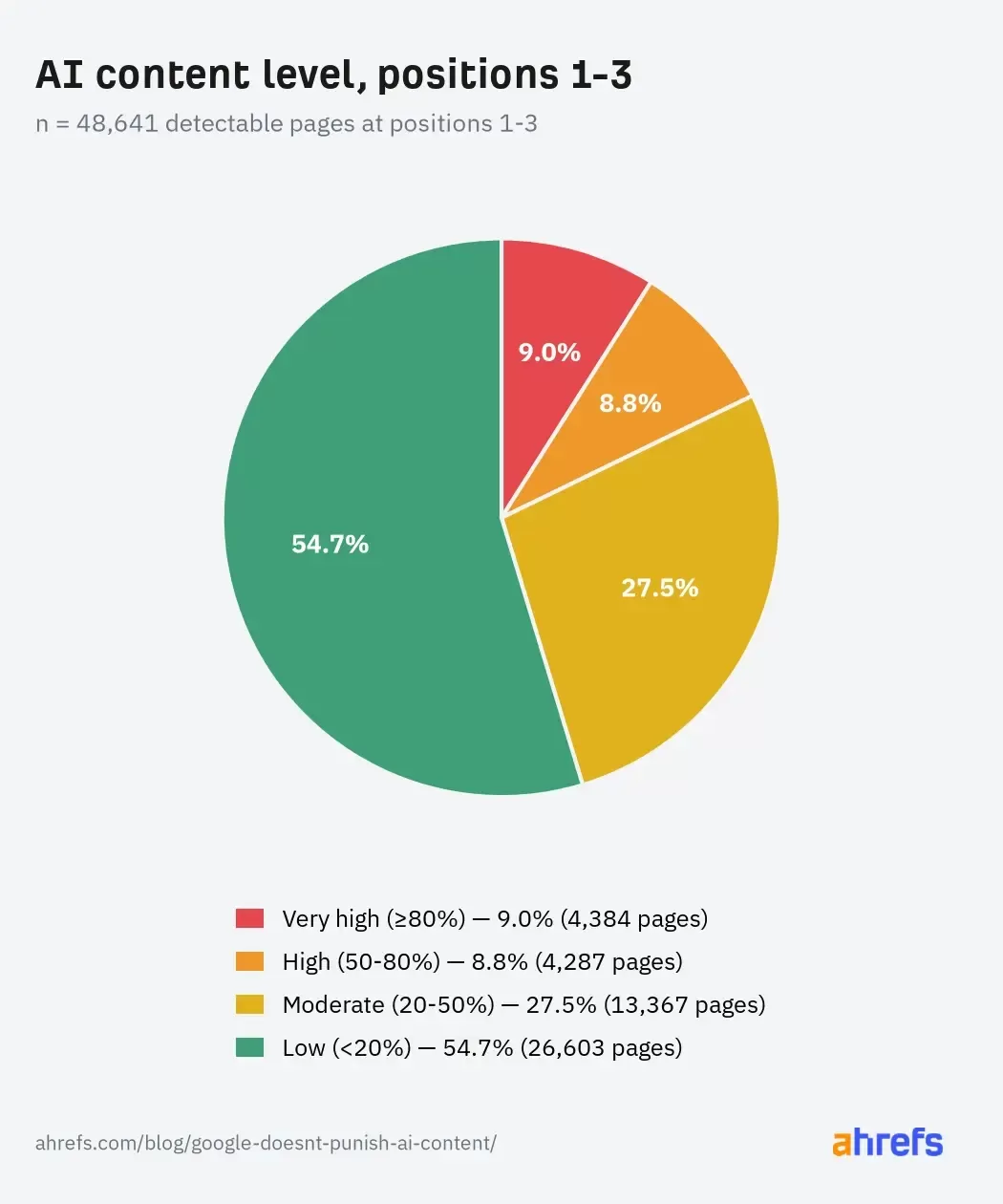
Focusing purely on detection therefore reduces a strategic problem to a technical one. For a brand, the bigger risks are publishing inaccurate information, presenting expertise that was never genuinely involved in the content, mass-producing pages to manipulate visibility or releasing derivative material that adds nothing to what already exists.
The control question should be simple: if we removed the company name from this content, could almost any competitor publish it without changing very much? If the answer is yes, there is probably very little editorial advantage.
More bots does not mean we should write for bots
Another growing narrative argues that, because machines now account for a significant proportion of internet traffic, companies should start producing content primarily for agents and automated systems.
According to the Imperva Bad Bot Report 2026, automated traffic already represents more than half of the web traffic analysed. But request volume is not the same thing as audience size. A crawler requesting a million pages does not represent a million prospective customers.
That traffic includes search engines, monitoring tools, data collection systems, malicious bots and a growing number of AI agents. An increase in automated activity does not necessarily mean that the human audience has disappeared.
Agents will undoubtedly play a larger role in discovery, comparison and even purchasing decisions. This makes it increasingly important to publish information that is clear, structured, verifiable and technically accessible. But that does not mean replacing human communication with content written exclusively for machines.
Economic decisions are still ultimately connected to human needs. Content needs to be understandable to machines without becoming unconvincing to people.
We are automating a content model that was already broken
Long before generative AI arrived, many content strategies had already turned editorial production into an assembly line. Teams analysed the highest-ranking pages, created similar structures, expanded word counts, added specific entities and published another version of information that already existed.
Modern agent-based workflows may look more sophisticated, but many of them repeat exactly the same model. One agent analyses search results, another creates a brief, a third writes the article and a fourth assigns a quality score. If the output falls below a threshold, it is automatically returned to the loop for another rewrite.
The process can be impressive. The result is not always equally impressive.
An organisation can build an extremely efficient system for producing average content. It can multiply publishing capacity by ten or even a hundred. But if all those agents are learning from the same public pages, automation increases production without necessarily increasing differentiation.
This is where organisations risk automating the same weaknesses that were already present in traditional content production.
The real asset is point of view
Large language models are exceptionally good at synthesising what has already been written. That capability is valuable for research, organisation and execution. It is far less suitable as the source of editorial strategy.
A machine has not sat through a difficult client meeting. It has not implemented a digital transformation programme over several years. It has not managed hundreds of campaigns. It has not had to defend a decision in front of a board. It does not understand the exceptions that appear when a theoretically perfect framework meets operational reality.
That accumulated experience is precisely what makes content difficult to copy. Proprietary data, practical experience, analysis, mistakes, decisions, real cases and evidence-based opinions form what can be described as the brand's intellectual capital.
That is why a strong digital transformation strategy should not begin with the question "how many articles can we produce?" but with a much harder one: "what do we know that the market is not yet explaining in this way?"
AI as a co-pilot, not as editorial direction
The answer is not to stop using artificial intelligence. It is to separate the tasks where technology creates efficiency from those where human judgement creates advantage.
The thesis should come from the expert. Before any prompt is written, the business needs to define the argument, the audience, the decision it wants to influence and what the organisation genuinely believes about the subject.
AI can structure the thinking. Turning scattered notes into a coherent structure, identifying unanswered questions, summarising documentation or comparing approaches are high-value applications.
Research can be accelerated, but not fully delegated. AI can identify studies and potential sources extremely quickly. Someone still needs to verify the original source, the context, the methodology and whether the information is current.
Writing should preserve proprietary knowledge. Internal examples, specialist experience, company data and positions that require judgement should remain at the centre of the content.
Human review remains essential. Not simply to correct errors or improve sentences, but to answer the most important question: does this content genuinely deserve to be published?
Stop competing on content any AI can summarise
The widespread use of AI assistants is making purely informational content easier to synthesise. Definitions, basic explainers and articles that simply reorganise public information can increasingly be summarised without the user ever visiting the original source.
That does not mean abandoning informational content. It means increasing investment in what is harder to commoditise: proprietary research, informed opinion, case studies, tools, comparisons built on real-world experience, interviews, newsletters, events and practical resources that help people perform a task.
This is also where a consistent copy and content strategy becomes more valuable. The objective is no longer simply to feed an editorial calendar, but to build assets that continue generating trust, demand and opportunities over time.
Discovery is becoming increasingly fragmented
The most important challenge for the years ahead may not even be who writes the content. It may be the fragmentation of discovery.
Search no longer happens exclusively in a traditional search engine. Marketplaces, YouTube, social networks, communities, specialist platforms and AI assistants are all becoming part of the same decision-making process.
A person may discover a problem on social media, research potential solutions on Google, compare alternatives on a marketplace, ask an AI assistant for recommendations, consult opinions in a community and finally visit the brand directly before making a decision.
The journey is no longer linear. And no organisation controls the algorithms distributing that attention.
Search engine optimisation therefore remains highly relevant. But a modern approach to SEO and organic search should form part of a broader discovery ecosystem rather than operate as an isolated activity.
The strategic objective should move from traffic to ownership
Search engines, social networks, marketplaces and AI platforms all share one characteristic: visibility is rented. These platforms define the algorithm, change formats, adjust the rules and ultimately decide when a brand receives exposure.
Content therefore needs to achieve two objectives at once. The first is to appear wherever the audience is looking for information. The second, and more important over the long term, is to convert that discovery into a direct relationship.
A newsletter, community, active customer base, application, members' area, academy, recurring event or annual report can turn occasional attention into a habit.
This logic helps explain the strength of media organisations that have diversified the relationship they have with their audiences. A user may arrive through search, but they find several reasons to return without depending on an intermediary again.
The same principle applies far beyond media. A B2B company can publish an annual study that becomes an industry reference. A retail brand can create a community or editorial programme. A technology business can develop tools, benchmarks or educational resources.
The important thing is to create reasons to return without having to start again through someone else's algorithm.
Measure repeat attention, not only clicks
This shift also requires different metrics. Sessions, impressions, clicks and search rankings remain useful, but they tell us less when analysed in isolation.
Marketing teams should monitor growth in branded search, returning visitors, newsletter subscriptions, direct traffic, event registrations, use of tools and content, product adoption, community engagement, influenced commercial opportunities and revenue across journeys where content played a role even if it was not the last click.
The more interesting metric is no longer how many people arrived once, but how many chose to come back.
This shift in perspective becomes especially important in a world where AI agents may answer questions, compare solutions or complete tasks without necessarily sending referral traffic to the original website.
The future belongs to brands that use AI to increase differentiation
Artificial intelligence will continue to transform content marketing. Trying to stop that transformation would be unrealistic, as would ignoring the productivity gains the technology already provides.
But the advantage will not belong to the companies that build the largest number of agents or publish the highest volume of pages. It will belong to organisations that combine technology with specialist knowledge, practical experience, proprietary data and a recognisable perspective.
Use AI to research faster, organise better, review more rigorously, identify opportunities and remove repetitive work. Do not use it to decide what your company thinks.
In an environment where every competitor will have access to similar models, AI quickly stops being an exclusive advantage. What remains difficult to replicate is organisational experience, earned trust, a direct relationship with the audience and the ability to create content people seek out because they recognise the value of the source.
The real challenge of content marketing in the age of AI is not proving that a human wrote every word. It is building something useful, distinctive and credible enough for both humans and machines to recognise its value - and, above all, giving people a reason to return.
If you enjoyed this article, follow us on LinkedIn...
Add this news source to your preferences.



Rate this article







0 Comments