



 Comment
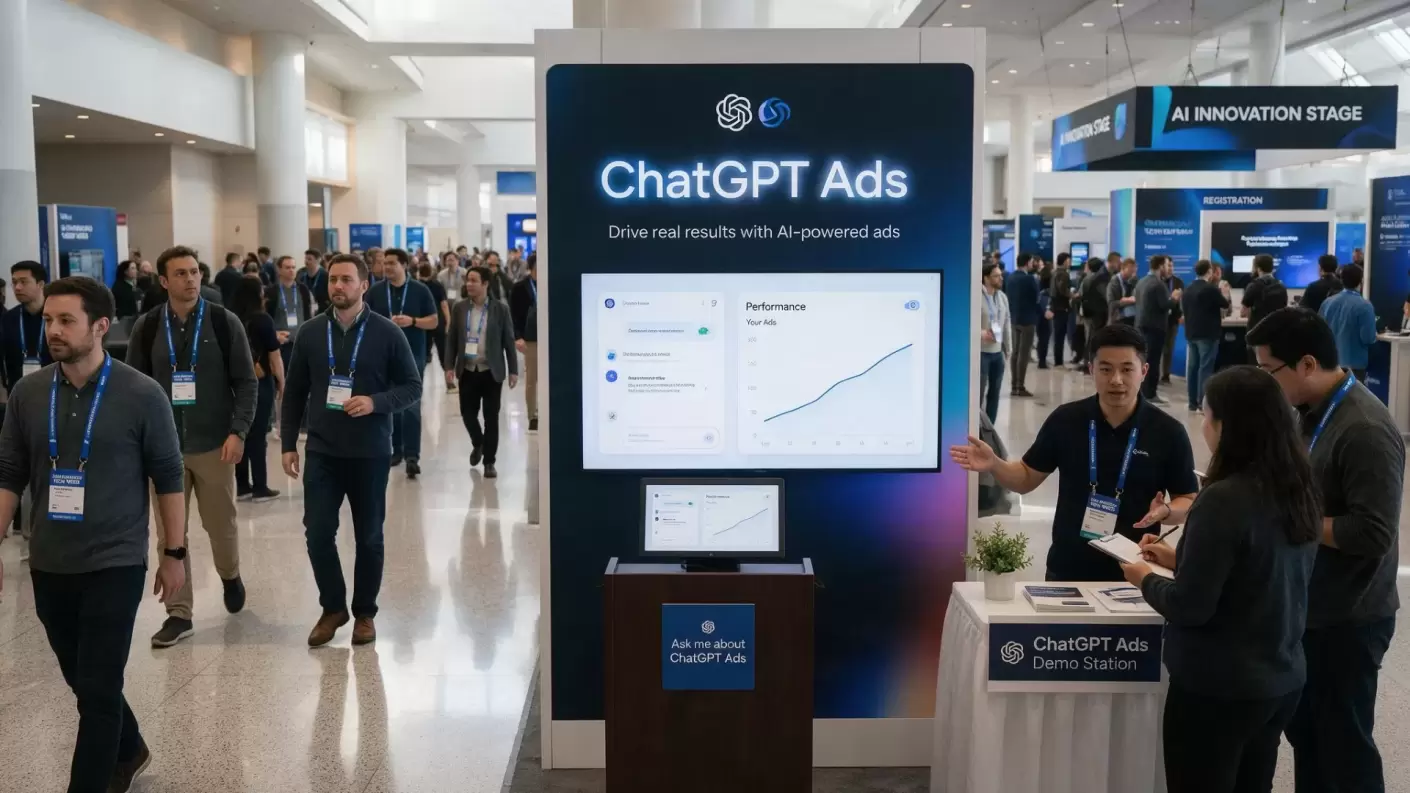
Advertising in ChatGPT opens up a new performance channel driven by context and intent. We explore its potential and share the results of our first tests.
Published on10 September 20263Views0 Reviews0 Comments

Digital marketing has gained a new advertising space. And it is not simply another inventory in which to place ads.
The introduction of advertising in ChatGPT puts brands inside an environment that is very different from what we have become used to in Search or Social: the conversation.
This difference may seem small, but it changes one of the most important variables in digital advertising: how we interpret the intent of the person on the other side.
A user who explains what they are looking for
On Google, a search such as “best CRM software” gives us a few words and a probable intent.
In a conversation with artificial intelligence, the same user might explain that they manage a sales team of 20 people, use Microsoft 365, receive leads through their website, need to automate sales follow-up and are looking for a solution within a specific budget.
For a marketing professional, the difference is clear: we are not simply dealing with a keyword. We are dealing with a contextualised problem or opportunity.
It is precisely within this environment that ChatGPT Ads become particularly interesting.
The potential is not simply about showing advertising to millions of users. It lies in the possibility of presenting a commercial message when there is a context that makes it relevant.
Advertising moves closer to the moment of decision
Much of the evolution of digital advertising has been an attempt to identify intent more accurately.
On Google or Bing, we do this through an entry in the search field. On social media, we use behavioural signals, interests, content and audiences. In remarketing, we use previous interactions with the brand.
Conversational AI adds a different signal: what the user is actually trying to solve.
Imagine someone using ChatGPT to compare ecommerce platforms, plan a trip, choose software for a company or understand what equipment they need for a particular project.
In many of these cases, the conversation takes place before a commercial decision. For advertisers, being present at that moment can have significant value.
Performance without traditional keywords
One of the mistakes we are likely to see in the early stages will be trying to transfer the Google Ads logic directly to ChatGPT.
Creating a list of keywords, writing a few headlines and expecting the model to work in exactly the same way would be an oversimplification.
In a conversational environment, the match between an ad and a user may depend far more on meaning than on a specific expression.
This forces us to think differently.
- What problems does our product solve?
- In which situations is it relevant?
- What type of user genuinely benefits from the solution?
- What argument should we present when a particular need is expressed?
These are long-standing marketing questions, but they regain importance in a system where context and intent may be worth more than an isolated keyword.
More variations, fewer generic messages
Creative work will also need to keep pace with this change.
For years, advertising platforms have moved towards greater automation of distribution. The advertiser's role has progressively shifted from choosing exactly where each ad should appear to providing the algorithm with better signals, content and objectives.
With ChatGPT Ads, this trend may become even more apparent.
A company may need several messages for different problems, needs and stages of the decision-making process.
An ecommerce platform, for example, does not only need to communicate that it allows users to “create an online store”.
It can address very different needs: migrating from another platform, selling internationally, integrating an ERP, improving conversion or reducing operational complexity.
The product is the same. The intent is not!
This is precisely where the quality of the strategy and the message can make a difference.
The landing page becomes fundamental again
There is another element that should not be overlooked: the destination of the click.
The more specific the intent that triggers an ad, the less sense it makes to send every user to a generic homepage.
If we know that a particular context is related to a specific need, the landing page should continue that conversation.
The message, value proposition, proof, content and conversion should all be aligned with what brought the user there.
This means that the arrival of new channels does not reduce the importance of brands' own assets.
It does precisely the opposite.
Excellent targeting combined with an unconvincing page is still a waste of budget.
The challenge will be measuring the true impact
Naturally, any new performance channel will have to answer the same question:
Does it work?
Impressions and clicks will not be enough.
Advertisers will need to analyse traffic quality, leads, sales, cost per acquisition and, above all, incrementality.
Would a user who clicked on an ad in ChatGPT have bought anyway through Google? Did ChatGPT introduce the brand into their consideration, or did it simply appear during a decision that had already been made? What role does this contact play in a journey that spans several channels?
These questions are not new.
But they become particularly relevant when we introduce another touchpoint into an attribution ecosystem that is already complex.
The first tests should be learning tests
At this stage, the question for many companies should not be “how much budget should we move to ChatGPT Ads?”.
It should be: what do we need to learn about this channel?
Which contexts generate the best results? Which value propositions are most relevant? Which products perform best? Which landing pages convert this traffic? What is the quality of the leads? How do these users behave after the first interaction?
This is how a new performance channel should be approached.
With a controlled budget, defined objectives and hypotheses that can be validated.
Not because it is new. But because it could become important.
Getting to work
And that is exactly what we did - we started our first tests so that we could build our own knowledge.
Our first questions were put to ChatGPT itself: what would the average CPC be?
The discouraging answer: 1.5 USD.
Even so, we did not give up and started preparing our first campaign for ourselves.
What were our expectations?
We were divided: some thought ChatGPT's information would be correct and that the cost per click would be very high, while others believed that the law of supply and demand would prevail and that, in this case, fewer advertisers would mean lower bids.
As for the other “usual” metrics, we expected a high CTR given AI's ability to contextualise a sponsored offer within a conversation. We felt the CTR should be close to 10%. Particularly because, at this stage, with relatively few advertisers, we did not believe OpenAI would be able to suggest several sponsored offers competing with one another for the click.
And what actually happened?
A CPC of 8 cents :) with a high CTR. This is wonderful for an advertiser. However, 14 clicks produced no conversions. But there certainly will be conversions if this performance continues. These were only 3 days of learning, and we will keep you updated on how this campaign is optimised and scaled to generate more impressions, more clicks and what conversion rate it ultimately achieves.
The early advantage will be knowledge
There is a tendency to look at new channels in one of two extreme ways: either they are presented as the next revolution that will replace everything, or they are ignored until there are enough results to eliminate practically all risk.
Neither approach is particularly useful.
Those who test early will make mistakes, run campaigns that do not work and encounter metrics that still need context.
But they will also begin building their own benchmarks.
And when a channel matures, that accumulated knowledge can become an important competitive advantage.
This has happened at several stages in the evolution of digital marketing.
With ChatGPT Ads, it will probably be no different.
The new performance channel is already beginning to take shape. What matters now is understanding not only how to advertise within it, but above all how to turn a relevant conversation into a business result. We have already started! Would you like to join us?
If you enjoyed this article, follow us on LinkedIn...
Add this news source to your preferences.



Rate this article





0 Comments